


General ADT features
In this subsection a general introduction to the ADT concept is given.
Subsequent sections treat typical ADT features of SDL-88.
Basic features
With a specification language it should be possible to specify a system on
an appropriate level of abstraction, and as implementation independent as possible.
Usually, abstraction allows to point out important features of an object while irrelevant
details are omitted. This also holds for data abstraction.
The concept of ADT is suitable in cases where the functional properties of
a data object should be described. An ADT defines the result of the application of a
function to a certain data object, but it does not tell how these results should be
achieved. The latter is up to an implementation of the data object.
In the most simple case, an ADT is a set of values, hereafter called sort,
together with a number of operators on this set. For example the set of natural
numbers, together with the addition and multiplication operator, form an ADT. In
mathematical notation, an ADT can be written down as a n-tuple, where the first component
is a set and the second to n-th components are operators. Therefore we could call (N,+,*)
an abstract data type.
In general an ADT can consist of more than one sort, and the operators may
have arguments of different sorts, but the results of the operators are always in one of
the sorts. In the following we will develop an example in which the ADT has the sorts natural
numbers and boolean. and various operators on these. As a summary, one can say
that
-
ADT = sorts + operators
The signature
For the definition of an ADT, we must first define the names of the sorts
and operators, and the domains and ranges of the operators. The notation used in the following
examples resembles the notation usually used in literature, e.g. [8].
ADT example
SORTS bool, nat
OPNS true :
->bool
false :
->bool
not : bool
-> bool
0 :
->nat
1
:
->nat
plus : nat,
nat ->nat
isZero : nat
->bool
In the example above, two sort names and 7 operator names are defined.
Together with the names of the operators, the domains and ranges are defined. Please note
that some of the operators do not have arguments, like true false, 0 and 1. Such
operators are called literals.
The names of the sorts and operators, together with the definition of
domains and ranges, are called signature of the ADT.
Terms
The literals define part of the elements of a sort. In general, a sort
may have many more elements.
The entirety of the elements of a sort can be generated by repeated
application of the operators to the elements of the sort. A combination of applications of
operators is called a term. A term is always of a certain sort, i.e. the range of
the outermost one.
Examples of terms of the boolean sort are:
true,
false,
not(true),
not(false)
not(not(true) ), ...
Terms represent elements of a sort. A term which represents an element of
a sort s, is-called s-term. The terms in the example above are therefore called bool-terms.
Every bool-term of the example above can be interpreted as an element of
the bool sort. This example already shows, though, that it is not desirable that
there is a one to one relationship between terms and elements of a sort. In general, the
set of terms will be much larger than the set of elements of a sort.
Given the signature of an ADT, we can successively generate the set of
terms. At the beginning we have the terms
In the next successive step, for every operator from the entire set of
operators of the ADT, terms are generated by applying the operators to the set of existing
terms. After this step, we have the set of terms
{1, 0, true, false,
plus(1,1), plus(1,0), plus(0,1), plus(0,0),
not(true), not(false),
isZero(1). isZero(0)}
Now we can apply the successive step again to generate more terms. Please
note that in this example in the set of generated terms there are terms of two different
sorts
bool-terms:
true, false, not(true), not(false), not(not(true)), not(not(false))
isZero(1), isZero(0), isZero(plus(0,0)), ...
nat-terms:
0, 1, plus(1,1), plus(1,0), plus(0,1), plus(0,0),
plus(plus(1,1),1) ...
The successive generation of terms results in an infinite number of terms.
Equations
Equations between terms specify which terms represent the same element of
a given sort. For example, the equation
specifies that the term not(true) and the term false represent
the same value of the sort bool.
With a set of equations, the set of terms can be divided into equivalence
classes. Every equivalence class then represents an element of the sort. In our example,
the set of bool-terms is divided into equivalence classes by the two equations
not(true) = false,
not(false) = true.
The respective equivalence classes are
{true, not(false), not(not(true)),...},
{false, not(true),not(not(false)),...}.
The equations can also be interpreted in another way. Equations specify
properties of operators. The properties of the not operator, for example, are that
it satisfies the equations above.
The equations can be defined in any order. Our ADT example can now
be extended in the following ways:
ADT example
SORTS bool, nat
OPNS true : ->bool
false : ->bool
not : bool -> bool
0 : ->nat
1 : ->nat
plus : nat, nat ->nat
isZero : nat ->bool
EQNS not(true) = false
not(false) = true
…
Sometimes it is not possible to specify all desired properties of an
operator with a finite set of equations. With variables and the FORALL construct, the
equations can be "parameterised". Examples can be found in the following
subsection.
The reduction of the set of terms, representing different elements of a
sort, shall now be demonstrated with the plus operator. In the following, the properties,
i.e. the equations, for the plus operator are introduced stepwise. plus generates the
following nat-terms
0
<- terms without plus
1
plus (n , 0)
<- terms with one plus
plus (C, 1)
plus (1, 0)
plus (1 , 1 )
plus (plus (0, 0), 0)
<- terms with two plus
plus (plus (0, 0) ,1)
plus (plus (0, 1), 0)
plus (plus (0, 1), 1 )
plus (plus (1, 0), 0)
plus (plus (1, 0), 1 )
plus (plus (1, 1), 0)
plus (plus (1, 1), 1)
plus (0, plus (0, 0) )
plus (0, plus (0, 1) )
plus (0, plus (1 0))
plus (0, plus(1,1))
plus (1 ,plus (0, 0) )
plus (1 plus (0, 1) )
plus (1, plus (l, 0))
plus (1, plus (1, 1))
…
<- terms with three plus
…
The symmetry property of the addition
The amount of terms representing different elements of the nat-sort can be
reduced by introducing the symmetry property of the addition. For any terms x and y, the
terms plus (x, y) and plus (y, x) shall be identical. We specify this property by a
parameterised equation:
FOR ALL x, y: nat
plus (x, y) = plus (y. x)
With this equation the set of terms representing different elements of the
nat-sort is reduced to the following
0
<- terms without plus
1
plus (0, 0)
<- terms with one plus
plus (0, 1)
plus (l, 1)
plus (plus (0,0), 0)
<- terms with two plus
plus (plus (0, 0), 1 )
plus (plus (0, 1), 0)
plus (plus (0, 1), 1)
plus (plus (1, 1), 0)
plus (plus (1, 1), 1)
…
<- terms with three plus
…
…
Addition of zero
The next property we want to specify is that addition of zero has no
effect This can be specified by the following equation:
FORALL x: nat
plus (x, 0) = x
With this equation the set of terms representing different elements of the
nat-sort is reduced to the following
0
<- terms without plus
1
plus (1, 1)
<- terms with one plus
plus (plus (1, 1), 1)
<- terms with two plus
plus (plus (plus (1, 1), 1), 1)
<- terms with three plus
plus (plus (plus (plus (1, 1), 1), 1), 1) <-
terms with four plus
We can now try to relate the remaining terms to the natural numbers:
0
= zero
1
= one
plus (1, 1)
= two
plus (plus (1, 1), 1)
= three
plus (plus (plus (1, 1), 1), 1) = four
plus (plus (1, 1), plus (1, 1) = four
…
…
The "addition" property of the addition
Something is still unsatisfying: the terms
plus (plus (1, 1), plus (1, 1)),
plus (plus (plus (1, 1), 1), 1)
specify the same element. Also, we have not said anything about the most
important property of the plus operator, namely the property that it really adds two
numbers and gives the correct result, e.g. 3 + 2 = 5, or in the terminology from above
plus (plus (plus (1, 1), 1), plus (1, 1) ) =
plus (plus (plus (plus (1, 1), 1), 1), 1)
Both problems can be solved by one additional equation:
FORALL x, y: nat
plus (x, plus (y,1)) = plus (plus (x, y),1)
With this equation it can be shown by induction on the number of plus in a
term, that any term can be written in one of the forms
0,
1,
plus (plus (.. (plus (1, 1), …, 1), 1)
and that the addition property manly holds.
A complete definition of the ADT example, including the equations for the
operator isZero, can now be given as follows:
ADT example
SORTS bool, nat
OPNS true : ->bool
false : ->bool
not : bool -> bool
0 : ->nat
1 : ->nat
plus : nat, nat ->nat
isZero : nat ->bool
EQNS not(true) = false
not(false) = true
FORALL x, y: nat
plus (x , y ) = plus (y , x)
plus (x, 0) = x
plus (x, plus(y, 1)) = plus (plus (x, y),1)
isZero (0) = true
isZero (plus (x, 1)) = false
The SDL data type concept
An SDL system description is constructed in a hierarchical manner. and the
structure can be represented as a tree. such as the one in figure
4. At any place in the
tree there may be descriptions of sorts, operators and equations.
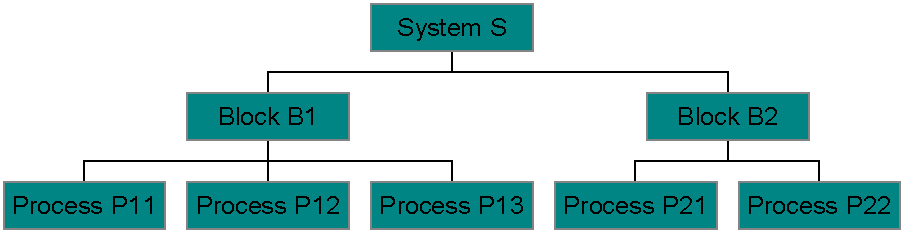
Figure 4 (from Basic
system structure)
A sort is specified in SDL, together with operators and equations, in so
called partial type definitions.
At any point in a system description tree, there is only one abstract
data type. It is defined by the sorts, operators and equations introduced by the partial
type descriptions from the root of the tree to the point in question.
Consider process P11 in figure 4: the ADT at this point
is defined by the partial type definitions in P11, B1 and S.
If (for example) in S the partial type definition has:
sorts: sor1, sor2,
operators: op1, op2, op3, and
equations: eq1, eq2
and in B1 the partial type definition has:
sorts: sorA, sorB, sorC
no operators, and
equation: eqA
and in P11
no sorts are defined, but the there is are definitions of
operators opA, opB, and
equation: eqB
then implicitly in P11 the complete ADT with
sorts: sor1, sor2, sorA, sorB, sorC,
operators: op1, op2, op3, opA, opB, and
equations: eq1, eq2, eqA, eqB
is defined and can, for example, be used to declare data.
An ADT thus only
exists implicitly in SDL, and does not have a name. Partial types which are not defined in
the direct hierarchy of a certain process (or block) are not relevant for this process
(or block, respectively). Thus in the example of figure 4 it is completely irrelevant for
P11 which partial types are
defined in B2 or P21. Certain rules have to be obeyed when specifying partial data types
hierarchically. For these the reader is referred to [1].
![[SDL Forum Society - Logo]](../images/logo.gif)
